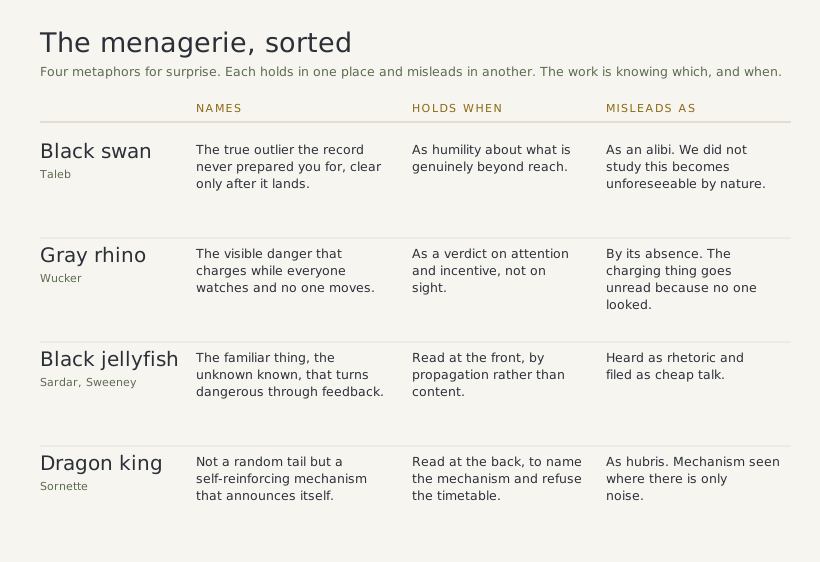
The vocabulary of uncertainty has filled with animals. Nassim Taleb's black swan, the outlier nothing in the record prepares you for, vast in effect and obvious only in hindsight [1]. Michele Wucker's gray rhino, the visible danger that charges while everyone watches and no one moves [2]. The black jellyfish of Ziauddin Sardar and John Sweeney's postnormal futures, the familiar thing that turns dangerous through feedback [3]. The terms are useful, and they are not interchangeable. Each names a different kind of surprise.
But a typology of surprises is a retrospective instrument. It sorts the creature after it has bitten. Used at the front of the work rather than the end, the animals do something quieter and worse: they let an analyst convert "we did not study this" into "this was a creature, unforeseeable by nature." The swan becomes an alibi. The real question is rarely which animal. It is whether the surprise was ever a surprise. Two reads from our own files say that, more often than the menagerie admits, it was not. They say so in different ways, and the difference is the point.
The first began with a word. In the late winter of 2026 the term Yellow Line, until then a fact of the war in Gaza, started to surface in Israeli political language about southern Lebanon. It appeared in an opposition interview, in a centrist security paper, in a statement from a lobby of displaced northern residents. Each instance was small and deniable, the kind of line a politician says and is expected to walk back. Read as content, it was noise. Read as propagation, it was a doctrine in transit. A word does not cross from one theater into another by accident, and it does not carry only itself. Yellow Line arrived with its template: a line declared temporary, marked in concrete, called a border, then moved quietly deeper. What made it doctrine rather than slogan was the spread, the same term crossing the whole Israeli spectrum at once, from the governing coalition to the likely next government to a grassroots lobby amplified by the country's largest political platform. Grassroots demand, media amplification, political adoption. That sequence is a known mechanism for turning a marginal position into state policy, and it was running in the open.
This is the black jellyfish in its exact sense, and the jellyfish is the most honest animal in the menagerie. The collective noun is theirs too: Sardar and Sweeney grouped these creatures and called the set a menagerie. Alone among them the jellyfish is about complexity and feedback rather than the arithmetic of rare events. It names the thing we believe we already understand, the unknown known, that turns consequential through the way it spreads. But Sardar and Sweeney leave it as description. The metaphor tells you the world contains jellyfish; it does not tell you how to net one. The netting is the addition. You catch a jellyfish by reading propagation rather than content, the feedback rather than the statement. We logged the word not because any one speaker meant it, but because it was multiplying. That is a discipline of recognition, exercised at the front end, before the thing has a body. Its failure mode is the analyst who hears rhetoric and files it as cheap talk.
The second read points the other way. By early May 2026 the violence around Nabatieh did not look like a turning point. Airstrikes hit the city's core on 7 May; the same morning brought evacuation orders for three district villages; the day before, a strike in Beirut had killed a senior commander and two officers with him. Inside a ceasefire still formally holding, this read to most as another bad week, discrete and deniable. We read it as a determined axis opening, and the determination sat in structure, not in any single strike. Hezbollah's fire on Israeli border communities came from the ridges of Iqlim al-Tuffah above Nabatieh, ground the Litani buffer could not reach; a single March barrage had put some two hundred rockets into Israel from that cluster. The stated Israeli objective was fire control over the whole district, anchored on a set of strategic sites held before the withdrawal of 2000, sites that sit on those ridges. The forces to take them were already in place to the south. Geometry, objective, capability. The offensive was not a contingency the future might or might not deliver. It was a mechanism with one outlet, already emitting precursors.
This is the case Taleb's swan misreads and Didier Sornette's dragon king explains [4]. The swan, for all its force against the conceit of prediction, is defined after the fact, which makes it unfalsifiable as a working category and convenient as an excuse; it cannot tell a true outlier from a thing the analyst failed to study, and Taleb's own answer, to build for robustness rather than sight, is a way of surviving the future, not of reading it. Sornette's correction is that many extremes are not the random tail of a distribution but the product of identifiable, self-reinforcing mechanisms that announce themselves before they break. The 2008 crisis, in his account, was a system organizing toward a threshold in plain view. Nabatieh was such a system. And yet the dragon king carries its own hazard, the mirror of the swan's fatalism: applied too freely it becomes hubris, a habit of seeing mechanism where there is only noise, confidence dressed as rigor. Sornette's own domains, finance and earthquakes and failing materials, offer far more data than a single political theater ever will. The discipline is not to choose the swan or the dragon king but to know where each holds. The read named the axis with the dragon king's confidence and held the offensive's depth and pace with the swan's humility. It called the mechanism and refused the tempo. Its scenarios were framings of where pressure led, not odds; it said plainly that the shape of the thing sixty days out was indeterminate, hostage to decisions no analysis could timestamp, while the structural pull toward those ridges and the exhausted humanitarian ground beneath any offensive were not indeterminate at all. That is a discipline of calibration, exercised at the back end, after the signal has been classified. Its failure mode is the analyst who, having seen the mechanism, mistakes it for a timetable.
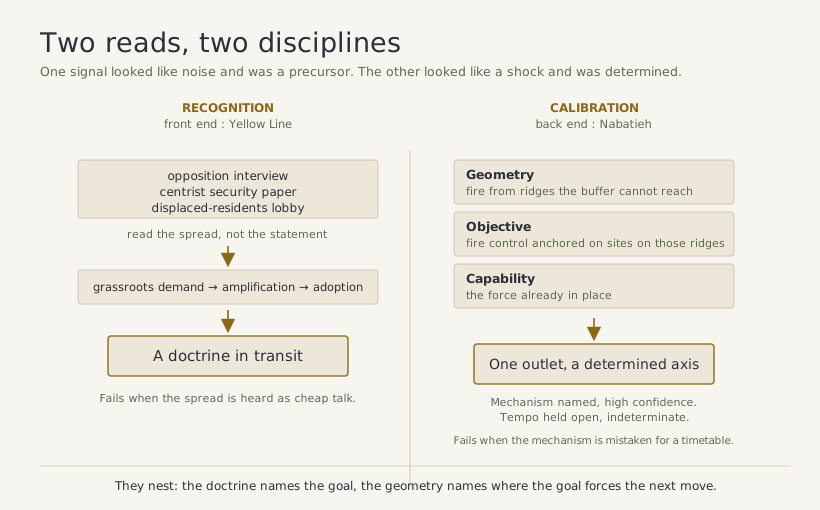
Set side by side, the two reads name the two ways the menagerie misleads. One signal looked like noise and was a precursor; the other looked like a shock and was determined. Recognition at the front, calibration at the back. The cases also nest, which is the deeper point. The doctrine read named the goal, a permanent fire-controlled zone; the geometry read named where that goal forced the next move. A condition at one level producing an event at another. This is where Wucker's gray rhino finds its place, mostly by its absence. Neither Lebanese read was hidden. Both were charging in full view, and both went largely unread anyway, which is the rhino's real and unglamorous lesson. Most foresight failures are not failures of prediction. They are failures of attention and incentive. That gap is the subject of the companion piece in this track, The Cost of Not Looking. The menagerie's deepest flaw is that it locates the strangeness in the world, in swans and jellyfish, when it usually lives in where the observer placed the instrument.
That is the whole of it. The scattered, low-grade material in both cases was assembled at machine scale, across sources too weak and dispersed for any single reader to connect; the judgment that the word was multiplying, and that the lines around Nabatieh converged on one place, was human. That interlock is the instrument we call Convergence, and the corroboration is the method, not the conclusion. The boundary between the unforeseeable and the diagnosable is not a fact about the world. It moves with where the instrument is set.
None of this is abstract, and the Nabatieh read did not let it become so. It measured the cost. An offensive at the tempo already seen further south would drive hundreds of thousands from a Shia-majority district onto a reception system that had already failed, with no working hospital left below the Litani and Nabatieh's own the next to go. The historic souq was already damaged. The archaeological site at Harouf was already gone. The city was, on the eve of all this, almost wholly intact, and that intactness was precisely what made the projected loss so large. In the weeks since, the offensive the read named has opened around Nabatieh, along the curve the file described. The files are dated [5]. The reader can check them against what came.
This is foresight done honestly. Not prophecy, and not the shrug the animals invite. It is the steady work of turning one beast at a time into a mechanism you can watch, classifying the signal at the front and calibrating the claim at the back, and naming without flinching the few that stay beyond reach. The test of the practice is not how many animals it can name. It is how few it needs to.
Notes
1. Nassim Nicholas Taleb, The Black Swan: The Impact of the Highly Improbable (New York: Random House, 2007).
2. Michele Wucker, The Gray Rhino: How to Recognize and Act on the Obvious Dangers We Ignore (New York: St. Martin's Press, 2016). Wucker introduced the term at the World Economic Forum in 2013.
3. Ziauddin Sardar and John A. Sweeney, "The Three Tomorrows of Postnormal Times," Futures 75 (2016): 1-13. The black jellyfish is theirs, as is the term menagerie for the set of postnormal potentialities. The wider theory traces to Ziauddin Sardar, "Welcome to Postnormal Times," Futures 42 (2010): 435-444.
4. Didier Sornette, "Dragon-Kings, Black Swans and the Prediction of Crises" (2009), elaborated in Didier Sornette and Guy Ouillon, "Dragon-kings: Mechanisms, statistical methods and empirical evidence," European Physical Journal Special Topics 205 (2012): 1-26.
5. The two analyses referenced are Core Group Source Files of record: the read on the Yellow Line doctrine (late winter 2026) and The Nabatieh Axis (8 May 2026). Links to the public editions accompany the online version.