Approach Solutions Analysis About Request a Briefing
BEIRUT DAMASCUS ANKARA BAGHDAD NICOSIA RIYADH
Beta

Convergence

Where signals meet. Where patterns emerge.

Scroll
I

The Problem

War is noisy.

When conflict erupts, information floods in from every direction - satellite imagery, social media, government statements, news wires, radio intercepts, casualty reports, flight trackers, fire detectors, diplomatic cables. Each source tells a fragment of the story. No source tells the truth.

A rocket hits a building in southern Lebanon. Al Jazeera reports civilian casualties. The IDF claims a weapons depot. Telegram channels post unverified footage. NASA detects a thermal anomaly. The MoPH updates its death toll. A diplomat in Geneva references the strike in ceasefire negotiations.

These are not separate events. They are one event, seen through different lenses.

But today, analysts sit in front of fifteen browser tabs, three Telegram groups, two TV screens, and a spreadsheet. They manually cross-reference. They miss connections. They arrive at conclusions hours after the pattern was already visible in the data.

People die in the gap between signal and understanding.

II

The Principle

No single source is trustworthy. No single domain is sufficient. Truth lives at the intersection.

An airstrike report from one news outlet is a claim. The same report confirmed by a second outlet from an opposing editorial bias is a signal. That signal correlated with a NASA fire detection at the same coordinates within thirty minutes is intelligence.

We call this convergence - the moment when independent signals from different domains, different sources, different methodologies point to the same reality. The more domains that converge, the higher our confidence. The fewer that converge, the louder our skepticism.

This is not a technology principle. It is an epistemological one. In a world of information warfare, deepfakes, and state propaganda, the only defensible path to truth is triangulation across independent, diverse sources.

III

The Architecture of Understanding

Convergence organizes the chaos of conflict into nine domains of observation:

No single domain tells the full story. A purely kinetic view misses the humanitarian catastrophe. A purely diplomatic view misses the ground truth. A purely media view mistakes coverage for reality.

KINETIC

the violence itself. Airstrikes, rockets, drones, artillery, ground clashes. Where, when, what weapon, what target.

HUMANITARIAN

the human cost. Casualties, displacement, shelters, aid corridors, vulnerable populations. The numbers that quantify suffering.

MEDIA

the information ecosystem. Not what is reported, but how it is reported. Coverage gaps, narrative divergence, source speed, editorial bias.

SOCIAL

the unfiltered signal. Telegram bursts, disinformation flags, volume spikes, channel credibility. The raw, messy, often unreliable but sometimes first-to-know layer.

POLITICAL

the actors. State and non-state, their statements, their actions, the gap between the two. Power dynamics, internal tensions, factional maneuvering.

DIPLOMATIC

the negotiations. Active talks, proposed frameworks, stalled processes, escalation and de-escalation signals. The search for an exit.

INFRASTRUCTURE

the skeleton of a society. Airports, roads, bridges, hospitals, telecom, power. When infrastructure fails, everything fails.

ENVIRONMENTAL

the land itself. Fires, chemical contamination, agricultural destruction, air and water quality. The scars that outlast the ceasefire.

ECONOMIC

the slow violence. Fuel prices, currency collapse, trade disruption, sector impact, supply chain failure. The war after the war.

Convergence watches all nine simultaneously. Always.

IV

The Engine

At the heart of the platform is a simple mathematical question: are these events related?

Two kilometers. Thirty minutes. Two independent sources from different domains.

When an airstrike is reported by a news agency, a fire is detected by a satellite, and a Telegram channel posts footage - all within two kilometers and thirty minutes - the engine doesn't just list three events. It creates a convergence cluster. It scores it. It escalates it. It demands analyst attention.

The parameters are not arbitrary. Two kilometers is the blast radius of reality - the zone within which multiple observers would witness the same event. Thirty minutes is the human latency of reporting - the window within which independent sources react to the same stimulus. These numbers are calibrated by ground knowledge, not by algorithm.

The engine is deliberately conservative. It would rather miss a connection than fabricate one. False convergence is worse than no convergence, because it creates false confidence. Every cluster that reaches FULL status has earned it through independent corroboration across domains.

V

The Analyst's Role

The platform ingests, classifies, correlates, and presents. It detects patterns that humans would miss in the noise. It calculates escalation scores. It flags anomalies - first mentions, unusual patterns, new capabilities.

But it does not conclude. It does not recommend. It does not decide.

The ELEVATE / PROMOTE / DISMISS workflow exists because a machine can detect that three signals converged, but only a human can judge whether that convergence means an escalation, a coincidence, or a deception. The analyst reviews, contextualizes, and acts. The platform serves the analyst, not the other way around.

Every convergence cluster is an invitation to think, not a command to act.

VI

The Bias Problem

All sources are biased. This is not a flaw to be eliminated - it is a feature to be exploited.

When Al Jazeera and the Jerusalem Post report the same event with the same facts, that cross-bias confirmation is worth more than ten reports from a single editorial perspective. When they diverge, that divergence is itself intelligence - it tells us something about what each side wants the world to believe.

Convergence tracks source bias not to filter it out, but to weaponize it for truth. The bias cross-check doesn't ask "which source is right?" It asks "do sources with opposing incentives agree?" When they do, confidence rises. When they don't, the analyst is warned.

A platform that only ingests "trusted" sources is a platform that has already chosen a side. Convergence ingests everything and trusts nothing - until convergence is achieved.

VII

The Platform

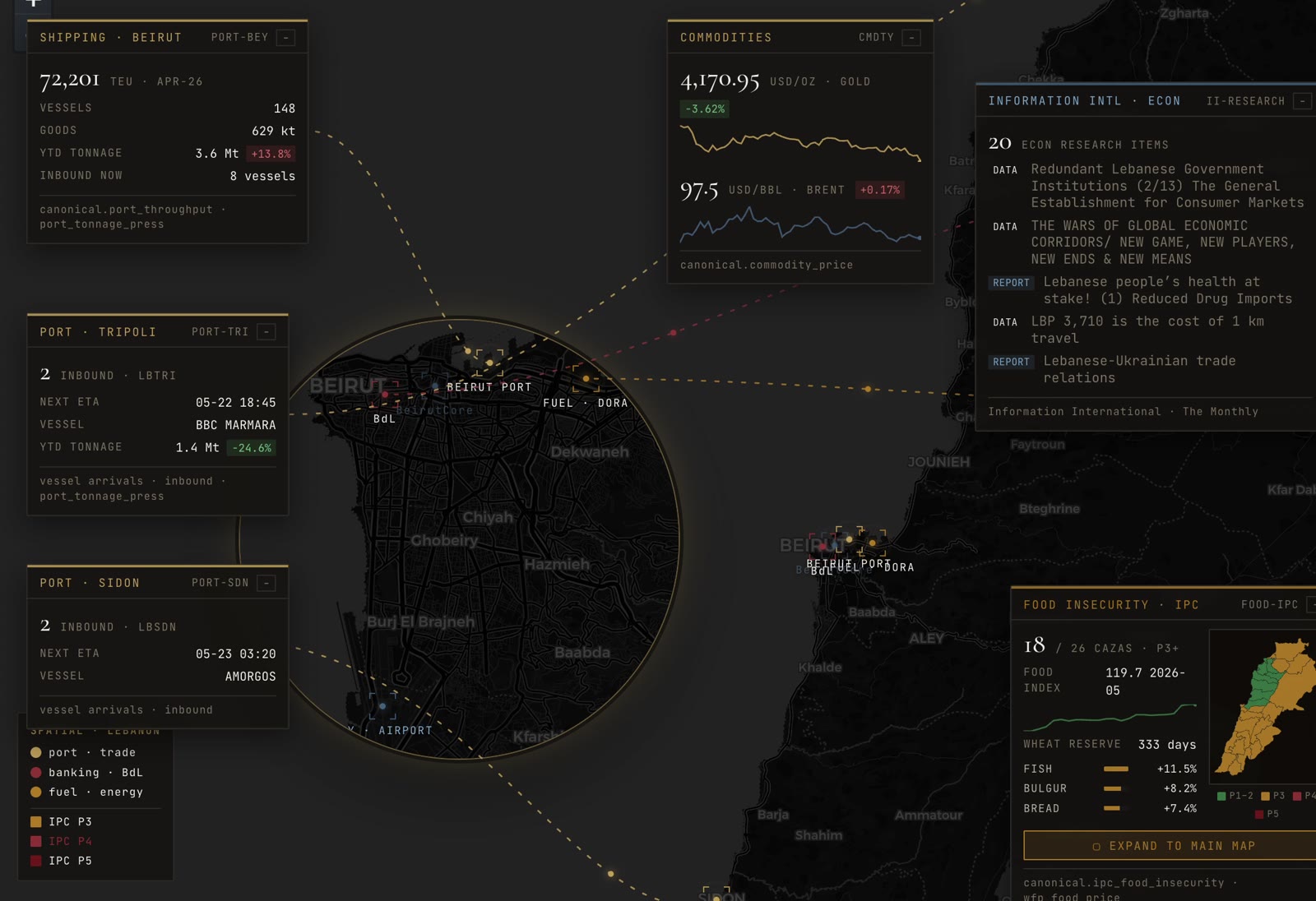
Nine domains. One analytical surface. Every signal classified, correlated, and scored in real time. The analyst chooses the lens: one hour, six hours, twenty-four hours, seven days. The platform renders the truth at that resolution.

Convergence BETA
HOMEKINETICMEDIASOCIALPOLITDIPLOINFRAHUMANENVIRECON
LIVE
Feed
HUMANCRITICALCONV
MoPH Casualty Report: 55 killed, 160 wounded
10h · moph-casualties BEY
KINEHIGHCONV
Strike cluster: 28 kinetic events in South Lebanon
6h · multi-source SLB
DIPLOHIGHCONV
US-Iran talks stall as both sides reject framework
21h · jpost BEY
MEDIACONV
Coverage gap detected: 1 zone under-reported
3h · tv-monitor BEY
100
BEIRUT ZAHLE NABATIEH
Situation
Kinetic
17strikes23rockets59drones
Humanitarian
1.05Mdisplaced
Diplomatic
0active3stalled
Risk by Zone
BEYCRITICAL
SLBHIGH
NIS-HFAHIGH
BKAELEVATED
MLBELEVATED
NLBLOW
766
Events 24H
21
Convergence
80
Peak Escalation
18
Sources
VIII

The Honest Dashboard

Most dashboards lie. They show green when things are red. They hide what they don't know. They present confidence they haven't earned.

Convergence refuses to lie.

When a data source fails, the System Health panel shows red - not green with an asterisk. When MoPH hasn't updated in six hours, the casualty number shows a dash rather than a stale figure presented as current. When a convergence cluster is built from a single source, it stays PENDING - it does not graduate to FULL because the algorithm wants to impress.

The platform shows what it knows, acknowledges what it doesn't, and never fills the gap with speculation. An analyst looking at Convergence should trust that what they see is what the data actually says - nothing more, nothing less.

IX

Who This Is For

Convergence is built for people who need to understand conflict in real time and cannot afford to be wrong.

Intelligence analysts who synthesize multiple sources into assessments. Journalists who need to verify before they publish. Humanitarian workers who need to know where it is safe to operate. Diplomats who need ground truth to negotiate from. Researchers who need structured data about unstructured violence.

It is not built for spectators. It is not built for doom-scrolling. It is not built for entertainment.

Every feature exists because an analyst needed it. Every metric exists because a decision depends on it. Every signal exists because a life may depend on understanding it.

X

What We Believe

We believe that information asymmetry kills. When one side of a conflict controls the narrative, civilians pay the price. When analysts lack real-time intelligence, responders arrive too late. When diplomats negotiate without ground truth, agreements collapse.

We believe that open-source intelligence, rigorously cross-referenced and honestly presented, can close the information gap - not perfectly, not completely, but meaningfully.

We believe that no algorithm should have the final word on what is true. Machines detect patterns. Humans judge meaning. The combination is more powerful than either alone.

We believe that the fog of war is not inevitable. It is a failure of systems, not a law of nature. Better systems create clearer vision. Clearer vision creates better decisions. Better decisions save lives.

We do not claim to see everything. We claim to be honest about what we see.

Request Access

Convergence is available to intelligence analysts, journalists, humanitarian organizations, diplomatic missions, and researchers working on the Levant. Access is granted, not purchased.

Request a Briefing

Built in Beirut. Built during war. Built because it had to be.

Core Group, 2026