When people ask what I do, I still do not have a clean answer. I can say the words, foresight, analysis, conflict, mediation, and watch them land on nothing. The settled professions come with a slot the listener already owns. Doctor, lawyer, architect: you say the word and the picture arrives. Mine has no slot. The guesses people reach for are the wrong ones, a forecaster, which I am not, something to do with spying, which I am not either, or, most revealingly, a fortune-teller. After some time of this, I stopped treating it as a failure of phrasing. It is a fact about the field. The work has no settled place in the way people understand work, and that absence is not trivial. It is the small, daily version of a much larger problem.
The larger version is in the numbers. Ask senior leaders what most threatens them now and a clear answer comes back. Across the major 2026 surveys, geopolitical instability has overtaken everything else as the named risk to growth. Then ask what they do about it, and the answer inverts. In a McKinsey survey fielded in February 2026, the single largest capability gap was the ability to see material developments coming, named by nearly half of respondents. On the same body of work, around half of organizations run no scenario analysis at all. The thing leaders fear most is the thing they least systematically prepare for.
The abstention is not even. It has a shape, and the shape is the tell. Across the drivers surveyed, the share doing no scenario work was lowest on the routine and quantifiable, currency moves and trade terms, and highest on the structural and consequential. More than half did nothing on shifts in alliances. Restrictions on foreign investment were close behind. The discipline built for uncertainty was used least precisely where uncertainty was greatest. That is not laziness, and it is not a shortage of resources. It is a mistake about what the discipline is.
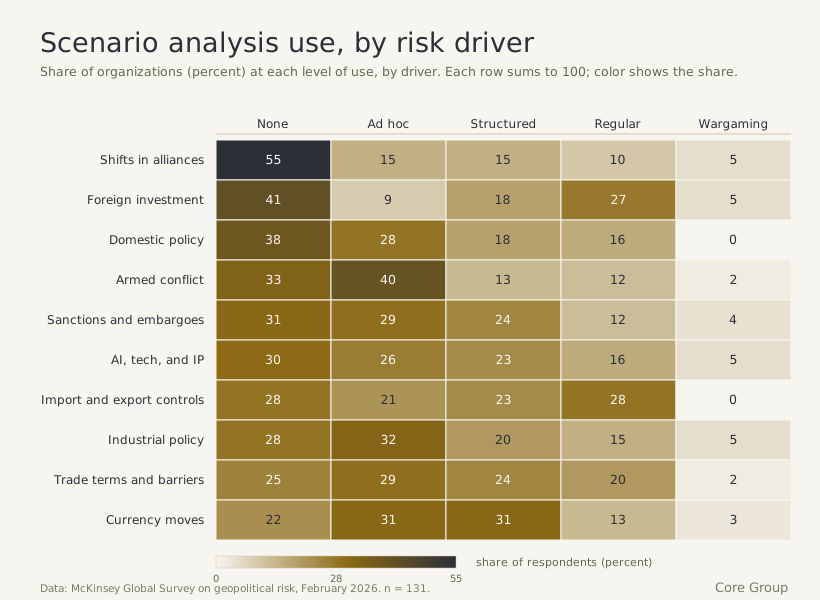
Most people equate foresight with prediction. They are right that the hardest drivers cannot be predicted. No one can tell you the day an alliance breaks or a capital regime closes. From a true premise, that these things cannot be foreseen as events, they draw a false conclusion: that nothing rigorous can be done, so the effort is wasted. The harder and less predictable the driver, the more obviously futile the work appears, and the more readily it is dropped. The pattern in the data is the fingerprint of that reasoning. Abstention rises with unpredictability because the abstainers believe foresight is prediction, and prediction is hopeless here, so they look away.
Foresight is not prediction. It does not tell you which future arrives. It is the disciplined preparation for more than one. It asks which futures are genuinely live, what would have to be true for each, what you would decide differently in each, and what to watch to know which one you are entering. It does not lift the uncertainty. It converts it. A fog becomes a small set of distinguishable conditions, each with a decision already attached and a signal that says it has begun. You still do not know what comes. You know what you will do when it does, and you know the signs that tell you which way it has turned. That is a capability, and it is the one the surveys report as most absent.
The error has a price, and the price is not abstract. Because the abstention concentrates on the highest-stakes drivers, the mistake is most expensive exactly where it costs the most. An organization that runs no scenarios on a shift in alliances is not skipping a minor exercise. It is walking unprepared into the decisions that will most determine what becomes of it. When the break comes it will have no live options, no triggers identified, no rehearsed response, and it will call the result a shock no one could have seen. The cost of not looking is not the work that was saved. It is the decisions that were never available to make.
Where I work there is a layer beneath that. In this region we have learned, across a long history of having our futures decided elsewhere, to assume that the forces shaping us are not ours to understand. Understanding is what others do, in capitals far away or in institutions with foreign letterheads. Our part is to absorb what arrives and react. The instruments of anticipation have reached us as imports, or as the apparatus of the state turned inward, never as an independent civilian institution that a society here might build for itself. So when the work goes unnamed, it is not only that the category is unfamiliar. It is that we have half-accepted the category belongs to someone else.
There is one homegrown image of future-talk here, and it is the wrong one. Each year the region gathers on the last night of December to watch an astrologer read the year ahead, the famous who will fall, the disasters that will come. It is an old and affectionate ritual, and it is divination, which is the exact inverse of the work. Divination treats the future as a single fixed thing already written, legible to someone with special sight, and waits to be told what it says. Foresight treats the future as plural and unwritten, open to anyone with method, and asks what to do about each version of it. One is revelation, and it ends in waiting. The other is preparation, and it ends in a decision. When the most familiar picture of telling the future is the one on the New Year broadcast, the work has no honest place to stand. It gets heard as a bid for the fortune-teller's chair, and the raised eyebrow that follows is fair. It is only aimed at a claim I am not making.
None of this means the region lacks for thought. The opposite is true. Nowhere argues about its own future more, or more ably. Every coffeehouse, every screen, every family table runs a standing seminar on what the powers intend and what comes next. We are, by appetite and by talent, a region of analysts. But analysis is not foresight, and the distance between them is the point. Most of what fills the air is commentary, reactive and opinionated and often brilliant, aimed at being right in the argument rather than ready for the decision. It explains the event after it lands. It dates nothing, risks nothing, and answers for nothing. Foresight is the discipline that commentary will not accept, a claim placed on the record before the fact and held to it after. So the two habits, the fatalism that says understanding is not ours and the torrent of talk in which everyone understands everything, are not opposites. They are the same absence in different dress. One treats the future as fixed and waits for it. The other treats it as spectacle and narrates it. Neither prepares, and neither decides.
That is the deeper failure, and it is not one of capability. The same open material, read with the same discipline, yields the same anticipations here as anywhere. Nothing about this region resists being understood from within it. There is only the long habit of assuming it cannot be, and the habit is its own kind of cost, paid in the decisions a place declines to believe it could ever have made for itself.
None of this argues that foresight is easy, or that most of what carries the name is any good. Done seriously, the discipline is accountable in ways the performance is not. It is dated, so it can be checked against what happened. It separates what it claims to know from what it admits it cannot. It is judged on outcomes rather than on how well it was delivered in the room. Most foresight fails those tests, which is part of why the whole category is discounted: the rigorous version is rare and the theater is everywhere, and from a distance they wear the same clothes. The pieces that follow in this track are the practice itself, set against real cases, so the difference can be seen rather than claimed.
The discipline is least used where it is most needed, and that gap is not a market curiosity to note and move past. It is a measure, very nearly an exact one, of how much is being left undecided in the places that decide the most. I still do not have a clean answer for the question at dinner. But I have stopped treating the difficulty as mine to apologize for. The work is hard to name for the same reason it is hard to value, and beneath both sits something older, the assumption that understanding this place, and deciding for it, belong to someone else. The misunderstanding can be cleared with an argument. The assumption is cleared only by doing the work, from here. Not the understanding of this region alone, but the decisions that are ours to make.